
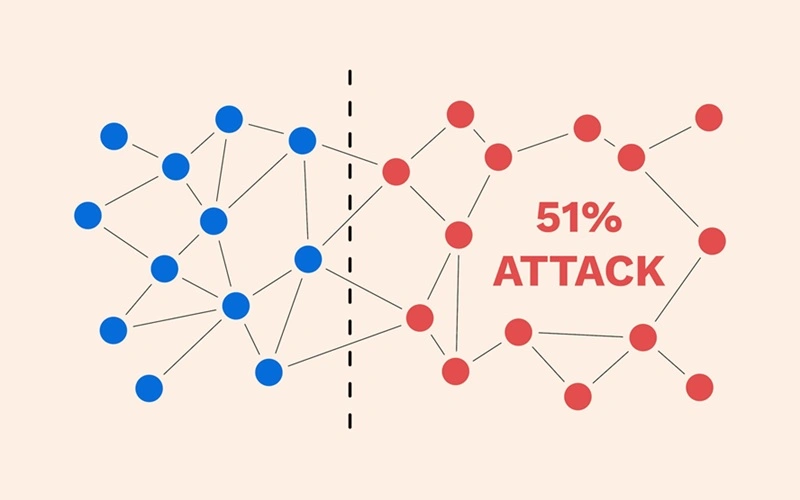
A 51% attack is a blockchain consensus attack in which an attacker or coordinated group gains enough control over a network’s consensus mechanism to influence which version of the blockchain is accepted.
On a Proof-of-Work (PoW) blockchain such as Bitcoin, this generally means gaining majority control of the network’s hashing power. On a Proof-of-Stake (PoS) blockchain, the equivalent attack involves controlling a sufficiently large proportion of the network’s staked assets or validator voting power.
A successful majority attack can allow an attacker to reorganize recent blocks, censor selected transactions, or potentially perform a double-spending attack. However, a 51% attack does not mean that the attacker can arbitrarily steal every user’s cryptocurrency or change the fundamental consensus rules of the blockchain.
Understanding exactly what a 51% attack can and cannot do is essential for understanding blockchain security.
What Is a 51% Attack?
A 51% attack, also called a majority attack, occurs when one entity or coordinated group gains enough consensus power to dominate the blockchain’s block-production or fork-choice process.
The exact meaning of “51%” depends on the blockchain’s consensus mechanism.
On Proof-of-Work blockchains
For PoW networks, the relevant resource is generally hash rate.
An attacker with majority hash power can potentially produce blocks faster than the honest portion of the network and use that advantage to build an alternative chain.
Bitcoin’s developer documentation explains that majority hash power is required to reliably execute a 51% attack against transaction history, although some attacks can have opportunities with less than 50% hash power.
On Proof-of-Stake blockchains
Proof-of-Stake systems work differently.
Instead of purchasing or controlling mining hardware and electricity, an attacker needs substantial control over the network’s staked assets and validator voting power.
For example, Ethereum’s current documentation explains that an attacker controlling more than 50% of staked ETH can dominate the fork-choice process, while larger thresholds provide additional capabilities.
Therefore, it is more accurate to think of a 51% attack as a majority-control attack against blockchain consensus, rather than assuming every blockchain uses mining hash rate.
Why Is It Called a 51% Attack?
The name comes from the idea of controlling more than half of the relevant consensus power.
If an attacker controls a majority of the resource used to determine the accepted chain, they may be able to consistently produce or support a competing chain faster or with greater voting weight than the honest participants.
For a PoW blockchain:
Majority hash rate → greater block-production power → greater ability to influence chain history
For a PoS blockchain:
Majority stake/voting power → greater consensus influence → greater ability to influence the canonical chain
The exact thresholds and consequences depend on the protocol.
This is why the term “51% attack” should not be interpreted as a universal mathematical rule that works identically on every blockchain.
How Does a 51% Attack Work?
To understand the attack, first consider how a blockchain normally works.
Transactions are broadcast to the network and validated according to the blockchain’s rules.
In a Proof-of-Work network, miners compete to produce valid blocks. Nodes then validate those blocks and follow the chain according to the network’s consensus rules.
Bitcoin’s blockchain uses cryptographic links between blocks, while Proof of Work makes rewriting historical blocks increasingly expensive as additional blocks are added.
You can learn more about this underlying mechanism in our guide to hashing in blockchain.
A simplified PoW attack
Imagine an attacker wants to reverse a payment they previously made.
The attacker could:
- Make a legitimate payment to a merchant.
- Allow the payment to enter the blockchain.
- Secretly begin mining an alternative chain.
- Create a conflicting transaction that spends the same coins elsewhere.
- Continue building the private alternative chain.
- Attempt to make the alternative chain become the chain recognized by the network.
Without majority hash power, the attacker normally cannot reliably keep up with the honest network.
With majority hash power, however, the attacker has a much greater ability to produce blocks and potentially reorganize recent transaction history.
This is the fundamental security concern behind a PoW 51% attack.
What Is a Blockchain Reorganization?
A chain reorganization, commonly called a reorg, occurs when nodes switch from one valid chain history to another according to the blockchain’s consensus rules.
Short reorganizations can occur naturally in some blockchain networks when competing blocks are produced close together.
A malicious majority attacker can deliberately create competing blocks in an attempt to replace part of the recent chain history.
Bitcoin’s documentation describes how competing forks can occur and how the network normally selects the chain with the greatest accumulated Proof of Work.
The longer the history an attacker attempts to replace, the more difficult and costly the attack generally becomes.
51% Attack and Double Spending
One of the most important risks associated with a majority attack is double spending.
Double spending occurs when the same cryptocurrency is effectively used in two conflicting transactions.
For example:
- An attacker sends 10 BTC to a merchant.
- The merchant sees the transaction and considers the payment confirmed.
- The attacker secretly builds an alternative chain.
- In the alternative chain, the attacker spends the same coins somewhere else.
- If the attacker’s alternative chain eventually replaces the relevant portion of the public chain, the original merchant payment can disappear from the accepted history.
This is why double spending is one of the most important consequences to understand when studying 51% attacks.
Poolyab also has a dedicated explanation of the double-spending problem, including how blockchain consensus is designed to prevent the same coins from being spent twice.
What Can a 51% Attacker Do?
The capabilities depend on the blockchain and the amount of consensus control obtained.
A majority attacker on a PoW blockchain may potentially be able to:
Reorganize recent blocks
The attacker may create an alternative chain and attempt to replace recently accepted blocks.
Perform double spending
If the attacker can successfully reorganize the relevant transaction history, they may be able to reverse their own payments and spend the same funds again.
Censor transactions
A sufficiently powerful attacker may refuse to include selected transactions in blocks they control.
Delay transactions
By controlling block production, an attacker may make it harder for particular transactions to be confirmed promptly.
Reorder transactions
Depending on the protocol and attack conditions, an attacker may influence the ordering of transactions in blocks they produce.
The exact capabilities vary considerably between networks.
What Can a 51% Attacker NOT Do?
This is one of the most important sections of any 51% attack explanation.
A majority attacker does not automatically gain complete control over a blockchain.
For example, controlling majority hash power does not normally allow an attacker to:
- Steal coins from arbitrary Bitcoin addresses without the required private keys
- Create valid transactions from someone else’s wallet
- Change the maximum supply simply by mining more blocks
- Ignore the blockchain’s basic transaction-validation rules
- Make invalid blocks valid
- Automatically steal funds locked by correctly functioning smart contracts
- Change consensus rules without the network accepting those changes
Nodes still validate blocks and transactions according to their protocol rules.
Bitcoin’s architecture is specifically designed so that nodes reject invalid transactions and invalid blocks.
Therefore, a 51% attack should be understood as an attack on consensus control, not as unlimited administrative access to the blockchain.
51% Attack vs. Blockchain Hack
A 51% attack is also different from what people commonly call a “blockchain hack.”
A hacker might attack:
- A cryptocurrency exchange
- A wallet
- A private key
- A smart contract
- A web application
- A bridge
- A user’s computer
- An API
- A centralized service
A 51% attack instead targets the consensus process of a blockchain.
For a broader look at the security challenges surrounding blockchain systems, see our guide to cybersecurity and blockchain.
It is also useful to understand that blockchain security has multiple layers. A blockchain can have strong consensus security while an application built on top of it contains a serious vulnerability.
51% Attacks on Proof-of-Work Blockchains
Proof of Work relies on computational resources.
Miners compete to find valid blocks by performing large numbers of cryptographic hash calculations.
The security assumption is that no single participant should be able to consistently control enough hash power to dominate honest miners.
Bitcoin’s developer documentation explains that majority hash power is what allows an attacker to reliably execute a 51% attack against transaction history.
However, the attacker’s objective matters.
An attacker does not necessarily need to rewrite years of blockchain history.
A more realistic objective could be to reorganize a relatively recent portion of the chain in order to reverse a payment or interfere with transaction confirmation.
Why Smaller Blockchains Can Be More Vulnerable
The cost of acquiring majority consensus power varies dramatically between blockchain networks.
Large networks may have enormous amounts of mining hardware or economic stake securing them.
Smaller networks may have:
- Lower total hash rate
- Less distributed mining
- Fewer validators
- Lower economic security
- Concentrated mining pools
- Lower attack costs
This can make majority attacks economically more feasible on smaller networks.
The security of a blockchain should therefore not be judged solely by the fact that it uses Proof of Work or Proof of Stake.
You should also consider:
- Network size
- Consensus participation
- Validator or miner distribution
- Economic value secured
- Hardware availability
- Stake concentration
- Mining-pool concentration
- Attack cost
- Community response mechanisms
Can Proof-of-Stake Blockchains Have 51% Attacks?
Yes.
Proof of Stake does not eliminate majority attacks. Instead, it changes the resource that an attacker needs to control.
On Ethereum, for example, the attacker would need control of a large proportion of the network’s staked ETH rather than majority mining hash power.
Ethereum’s documentation explains that 51% of staked ETH can allow an attacker to control the fork-choice process and perform actions such as transaction censorship and short-range reorganizations. Larger amounts of stake can enable more powerful attacks.
However, Proof of Stake introduces an important additional security mechanism: economic penalties.
Malicious validators can potentially have their stake slashed or otherwise penalized.
This changes the economics of an attack because the attacker may risk losing a substantial amount of capital.
51% Attack Thresholds Are Not Identical Across Blockchains
The phrase “51% attack” can sometimes make blockchain security sound simpler than it really is.
Different consensus systems have different attack thresholds and consequences.
For example, Ethereum’s current documentation identifies several important thresholds:
- Around 33% stake can create serious finality problems.
- More than 50% stake can provide control over the fork-choice process.
- Around 66% stake can provide significantly greater control, including the ability to finalize an attacker’s preferred chain.
These thresholds describe Ethereum’s specific Proof-of-Stake design and should not be generalized to every PoS blockchain.
The important lesson is:
Blockchain consensus security depends on the specific protocol, not simply on whether a network is called PoW or PoS.
How Expensive Is a 51% Attack?
There is no universal price for a 51% attack.
The cost depends on the blockchain.
For a Proof-of-Work network, an attacker may need access to:
- Mining hardware
- Electricity
- Mining infrastructure
- Network connectivity
- Operational resources
- Sufficient hash rate
For a Proof-of-Stake network, the attacker may need to acquire or control a large amount of the network’s stake.
The economic cost can therefore be extremely high for large networks.
But the cost can be much lower for smaller networks with limited consensus participation.
There is also an important distinction between the cost of obtaining majority control and the cost of successfully executing a particular attack. These are not necessarily the same.
Why Bitcoin Is Difficult to 51% Attack
Bitcoin has a very large Proof-of-Work mining ecosystem.
An attacker attempting to obtain majority hash power would need enormous computational resources and would have to maintain that advantage against the rest of the network.
Bitcoin’s Proof-of-Work design makes rewriting increasingly deep transaction history progressively more difficult because the attacker must reproduce the accumulated work of the chain they are attempting to replace.
This does not mean a 51% attack is mathematically impossible.
Rather, Bitcoin’s economic and computational security assumptions make sustained majority control extremely demanding.
How Blockchain Networks Defend Against 51% Attacks
There is no single security feature that completely eliminates majority attacks.
Instead, blockchain networks use a combination of technical and economic mechanisms.
1. Decentralized consensus participation
The more distributed mining or validator participation is, the harder it can be for one entity to obtain majority control.
2. Economic incentives
Mining rewards and staking rewards encourage participants to follow the protocol rather than attack it.
3. Confirmation depth
Users can wait for additional blocks before treating high-value transactions as final enough for their particular risk tolerance.
More confirmations generally increase the work an attacker would need to overcome on a PoW network.
4. Validator penalties
Proof-of-Stake systems can impose economic penalties on malicious validators.
Ethereum, for example, uses slashing and other mechanisms as part of its security model.
5. Monitoring and detection
Exchanges, miners, validators, and blockchain infrastructure providers can monitor unusual chain reorganizations, transaction patterns, and consensus behavior.
6. Network diversity
A healthy ecosystem benefits from diverse miners, validators, node operators, clients, and infrastructure providers.
How Users Can Reduce 51% Attack Risk
Individual users cannot prevent a blockchain-wide majority attack themselves, but they can reduce their exposure.
Wait for sufficient confirmations
For valuable transactions, accepting an unconfirmed payment or a payment with very few confirmations can create additional risk.
Use reputable exchanges and services
Professional services often monitor blockchain reorganizations and suspicious transaction activity.
Understand the blockchain you are using
Do not assume every blockchain has the same security characteristics as Bitcoin or Ethereum.
Consider network size and decentralization
A small blockchain with concentrated mining or validator participation may have a different risk profile from a large, highly distributed network.
Avoid assuming “confirmed” means “irreversible”
Confirmation provides increasing confidence, but the exact level of finality depends on the blockchain’s consensus design.
51% Attack vs. Other Blockchain Attacks
A 51% attack is only one category of blockchain-related attack.
| Attack type | Main target | Typical objective |
|---|---|---|
| 51% attack | Consensus | Control or reorganize chain history |
| Double spending | Transaction history | Spend the same funds twice |
| Private-key theft | Wallet credentials | Steal funds |
| Smart-contract exploit | Application code | Manipulate or drain a contract |
| Sybil attack | Network identity | Create many fake identities |
| Phishing | Users | Steal credentials or approvals |
| Bridge exploit | Cross-chain infrastructure | Manipulate asset transfers |
This distinction matters because the appropriate defense depends on the attack.
For example, smart-contract auditing is relevant to application-layer vulnerabilities but does not prevent a blockchain consensus attack.
Poolyab’s guide to smart-contract security and auditing explains how vulnerabilities in blockchain applications can be identified and reduced.
51% Attack vs. Double Spending
These two concepts are closely related but should not be treated as identical.
A 51% attack describes the attacker’s control over consensus.
Double spending describes a specific outcome in which the same funds are spent in conflicting transactions.
A majority attacker may use its consensus advantage to perform a double-spending attack.
Therefore:
51% attack = method or consensus attack
Double spending = possible consequence
Not every majority attack necessarily results in a successful double spend.
Can a 51% Attack Steal Your Bitcoin?
Not directly in the way that a private-key theft does.
A majority attacker cannot simply generate a valid Bitcoin transaction spending coins from an address they do not control.
The attacker would still need the relevant cryptographic authorization to create such a transaction.
The primary risk is instead manipulation of transaction history and consensus, such as reversing the attacker’s own payments or censoring selected transactions.
This is an important distinction between a consensus attack and a wallet compromise.
What Happens After a 51% Attack?
The response depends on the blockchain and the nature of the attack.
Possible responses can include:
- Increasing confirmation requirements
- Monitoring chain reorganizations
- Temporarily changing exchange deposit policies
- Coordinating with miners or validators
- Improving network decentralization
- Changing consensus parameters
- Social or governance responses
- In extreme cases, implementing a protocol change
The appropriate response depends heavily on the blockchain’s governance structure.
A decentralized blockchain does not have a single administrator who can necessarily “turn off” an attack.
51% Attacks and Blockchain Integrity
Blockchain security depends on more than cryptography.
Hash functions make unauthorized modifications detectable and help link blocks together, while consensus mechanisms determine which valid history participants recognize.
Our article on hashing in blockchain explains how cryptographic hashes connect blockchain data and contribute to Proof-of-Work security.
The important distinction is:
Cryptography protects the integrity of data structures.
Consensus determines which valid chain the network accepts.
A 51% attack primarily targets the second part.
Real-World 51% Attack Risk
Historically, majority attacks have been particularly associated with smaller Proof-of-Work cryptocurrencies where the cost of obtaining sufficient hash power was relatively low.
The broader lesson is that blockchain security is partly economic.
A technically sound consensus mechanism can still face practical risk if:
- Mining is highly concentrated
- The network’s hash rate is low
- Validators are highly concentrated
- Attack costs are low
- Large amounts of value are secured by a relatively small consensus set
For this reason, evaluating blockchain security requires looking at the actual network rather than relying solely on the name of its consensus algorithm.
How to Evaluate a Blockchain’s 51% Attack Risk
If you are researching a cryptocurrency or blockchain project, consider the following questions.
1. What consensus mechanism does it use?
Is it Proof of Work, Proof of Stake, or another mechanism?
2. How decentralized is consensus participation?
Look at the distribution of miners, mining pools, validators, or stake.
3. How much economic value secures the network?
A larger economic security budget can make attacks more expensive.
4. How much would an attack cost?
For PoW, consider hash-rate requirements and hardware availability.
For PoS, consider the amount of stake needed and the potential penalties.
5. What happens after an attack?
Does the protocol have finality mechanisms, slashing, monitoring systems, or other defenses?
6. How quickly would an attack be detected?
Detection can be critical for exchanges and other services that manage deposits and withdrawals.
51% Attack FAQ
What is a 51% attack?
A 51% attack is a blockchain consensus attack in which an entity or group gains majority control of the relevant consensus resource, such as hash power in Proof of Work or stake-based voting power in Proof of Stake.
Can a 51% attack steal all cryptocurrency?
No. Majority consensus control does not automatically give an attacker the private keys required to spend other users’ funds.
Can a 51% attack cause double spending?
Yes. A sufficiently powerful attacker may be able to reorganize transaction history and reverse their own transactions, potentially enabling double spending.
Can a 51% attacker change the Bitcoin supply?
No. A majority miner still has to follow the network’s consensus rules. Invalid transactions and blocks are rejected by nodes.
Does a 51% attack require exactly 51%?
No. The term describes majority control, but the exact threshold and attack capabilities depend on the blockchain. Bitcoin documentation notes that majority hash power enables reliable attacks on transaction history, while some attacks may have opportunities below 50%.
Can Proof-of-Stake blockchains be 51% attacked?
Yes. Ethereum’s documentation explicitly describes the possibility of a 51% attack using majority control of staked ETH. The consequences and defenses differ from Proof of Work.
Is Bitcoin vulnerable to a 51% attack?
Bitcoin’s consensus model theoretically permits a majority-hash-rate attack, but obtaining and sustaining the necessary majority hash power is extremely demanding. The practical risk depends on the distribution and economics of the mining ecosystem.
Is a 51% attack the same as hacking a blockchain?
No. A 51% attack targets the blockchain’s consensus process. A hack might instead target wallets, private keys, exchanges, smart contracts, bridges, or applications.
How can users protect themselves?
Users can reduce risk by using reputable services, waiting for appropriate confirmation depth for valuable transactions, and understanding the security characteristics of the blockchain they are using.
Final Thoughts
A 51% attack is one of the most important concepts in blockchain security because it demonstrates the relationship between decentralization, consensus, and economic security.
On Proof-of-Work networks, the attack involves gaining majority control of hashing power. On Proof-of-Stake networks, the attacker instead seeks sufficient control of stake and validator voting power.
A successful majority attack can potentially:
- Reorganize recent blocks
- Censor transactions
- Influence transaction ordering
- Enable double spending
- Undermine confidence in transaction finality
But it does not provide unlimited control over the blockchain.
Attackers still face cryptographic, economic, and protocol-level constraints.
The security of a blockchain ultimately depends on the combination of its consensus mechanism, decentralization, economic incentives, validator or miner distribution, network participation, and ability to respond to attacks.
Understanding these factors is essential when evaluating the security of any cryptocurrency or blockchain network.


2 thoughts on “What Is a 51% Attack? How Blockchain Majority Attacks Work”