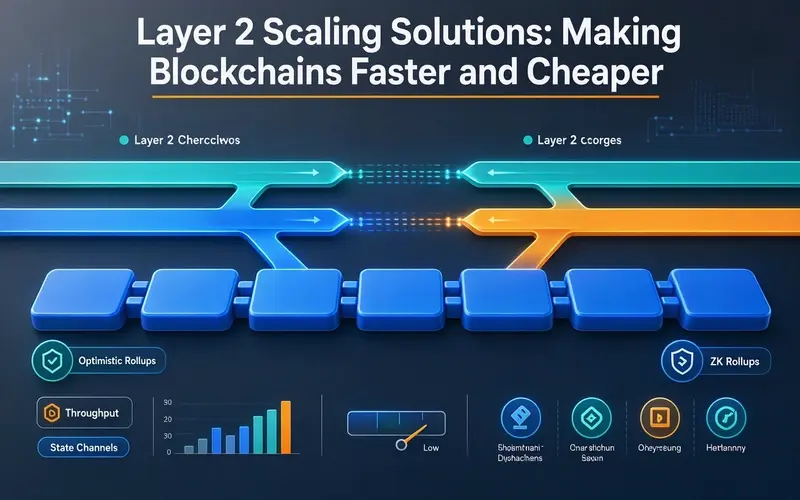
Blockchain networks can become congested when demand for transactions exceeds the capacity of the base layer. During busy periods, users may face higher fees, slower transaction processing, and difficulty using decentralized applications economically.
Layer 2 scaling solutions help address these limitations by processing transactions outside a blockchain’s base layer while relying on different mechanisms to settle, verify, or secure activity. On Ethereum, rollups are a major Layer 2 approach: they execute transactions separately and publish data or proofs to Ethereum according to their design.
Layer 2 systems can improve transaction capacity and reduce costs, but they do not all provide identical security guarantees. Their performance depends on architecture, network demand, data availability, and operational design.
What Are Layer 2 Scaling Solutions?
Layer 2 (L2) refers to protocols built on top of a base blockchain, known as Layer 1 (L1), to increase transaction capacity or improve the user experience.
Instead of requiring every transaction to be executed independently on the base layer, a Layer 2 system handles some activity separately. Depending on its design, it may batch transactions, use off-chain channels, or rely on other mechanisms to reduce the work required on Layer 1.
Common goals include:
- Higher transaction capacity: Handle more activity without placing every operation directly on the base chain.
- Lower transaction costs: Share settlement or data-publication costs across many transactions.
- Faster user experiences: Reduce the time users wait for certain application interactions.
- Broader application support: Make frequent transactions more practical for payments, gaming, decentralized finance, and other applications.
Layer 2 does not eliminate every scalability limitation. It redistributes work and introduces design trade-offs involving security, data availability, interoperability, and decentralization.
To understand the underlying problem, see Poolyab’s article on blockchain scaling challenges and transaction bottlenecks.
Why Do Blockchains Need Layer 2?
Public blockchains must coordinate transactions across distributed networks of participants. That coordination supports verification and decentralization, but base-layer capacity is limited by protocol rules, block space, computation, and data availability.
When demand increases, users compete for limited transaction capacity. Fees may rise, and applications that depend on frequent interactions can become expensive.
Layer 2 systems help by moving some transaction execution away from the base chain and using different settlement or verification mechanisms.
For example, a decentralized exchange may process many trades on a rollup and publish the required data to Ethereum in batches. This can distribute some base-layer costs across multiple users.
However, actual fees vary with network activity, transaction complexity, data costs, and the Layer 2’s own fee structure.
Main Types of Layer 2 Scaling Solutions
Several approaches can improve blockchain scalability. They differ in how they process transactions, settle results, and handle security.
1. Optimistic Rollups
Optimistic rollups execute transactions outside the base chain and publish transaction data or commitments to the underlying network. They generally assume submitted state transitions are valid unless a challenge process successfully demonstrates otherwise.
A fraud-proof or fault-proof mechanism can allow incorrect state transitions to be challenged under the protocol’s rules.
Potential advantages
- Support for general-purpose smart contracts.
- Reduced per-transaction settlement costs through batching.
- Compatibility with established development tools, depending on the rollup.
- Security that can depend on the underlying chain’s data availability and dispute mechanisms.
Limitations
- Withdrawals to Layer 1 may involve challenge periods or other delays.
- Proof systems and upgrade controls introduce implementation-specific risks.
- Sequencers may create temporary censorship or availability concerns.
- Actual security depends on the rollup’s operational and verification mechanisms.
Optimistic rollups are not automatically risk-free simply because they use Ethereum. Users should examine each network’s withdrawal design, upgrade permissions, and proof-system maturity.
2. Zero-Knowledge Rollups
Zero-knowledge rollups, often called ZK-rollups, execute transactions outside the base chain and submit cryptographic validity proofs that allow the underlying system to verify defined state transitions.
The term “zero-knowledge” describes a family of cryptographic techniques. In rollup systems, validity proofs can demonstrate that a state transition follows the rules without requiring the base chain to re-execute every transaction.
Potential advantages
- Cryptographic verification of state transitions.
- Efficient batching of transactions.
- Potentially faster withdrawal finality than systems that require a long fraud-proof challenge period.
- Support for a range of applications, depending on the proof system and execution environment.
Limitations
- Proof generation and verification can be computationally complex.
- Different systems vary in compatibility with existing smart contracts.
- Bridges, software bugs, upgrade keys, and data availability remain important risks.
- Withdrawal and finality times depend on the specific implementation.
A validity proof verifies defined computations or state transitions; it does not guarantee that every application is bug-free or that every off-chain input is accurate.
3. State Channels and Payment Channels
State channels allow participants to exchange signed updates off-chain while using a blockchain to establish or settle the channel’s state.
For example, two participants can make many payments between themselves without recording every payment individually on the base chain. Opening and closing the channel generally require on-chain interactions.
Potential advantages
- Efficient repeated payments between participants.
- Low marginal transaction costs after a channel is established.
- Fast updates for supported interactions.
- Reduced base-layer transaction load.
Limitations
- Participants may need to manage channel liquidity.
- Users may need monitoring or delegated watchtower services to respond to certain disputes.
- Channels are less suitable for some general-purpose applications involving many unrelated participants.
- Opening, closing, and routing payments can introduce additional complexity.
Payment channels are especially useful when participants exchange many transactions and can tolerate the channel’s operating requirements.
4. Plasma and Related Designs
Plasma is an approach in which child chains process activity separately and commit information to a parent chain. Its designs use exit mechanisms intended to help users recover assets under specified conditions.
Plasma introduced important ideas for scaling, but data availability, exit complexity, and support for general-purpose applications have limited its use in many settings. Rollups have become a prominent alternative for Ethereum scaling because they can publish transaction data to the base chain and use different proof mechanisms.
These systems should not be treated as interchangeable. Their security assumptions and recovery procedures vary substantially.
5. Sidechains: A Related but Different Approach
Sidechains are independent blockchains connected to another chain, usually through a bridge or peg mechanism. They may have their own validators, consensus rules, and transaction-fee markets.
Sidechains can provide higher throughput or specialized features, but they do not automatically inherit the security of the main chain. Their security depends on their own consensus and validators, as well as the bridge or peg used to move assets.
Sidechains are often compared with Layer 2 systems because both can reduce reliance on the main chain for transaction execution. However, many technical definitions distinguish independent sidechains from true Layer 2 protocols.
Read more in Poolyab’s guide to sidechains in blockchain.
Layer 2 Comparison Table
The following table summarizes the main differences between common scaling approaches.
| Feature | Optimistic rollups | ZK-rollups | State channels | Sidechains |
|---|---|---|---|---|
| Main approach | Execute transactions separately and allow challenges | Execute separately and verify state transitions with validity proofs | Exchange signed updates off-chain | Execute on an independent blockchain |
| Base-chain role | Settlement, data, and dispute resolution according to design | Settlement, data, and proof verification according to design | Open, dispute, and close channels | Usually provides the connection or bridge endpoint |
| Security model | Depends on fault-proof system, data availability, and upgrades | Depends on proof system, data availability, and upgrades | Depends on channel rules and dispute mechanisms | Depends on its own consensus and bridge |
| Typical strength | General-purpose scaling | Cryptographic validity verification | Frequent interactions among participants | Custom rules and independent operation |
| Key limitation | Challenge and withdrawal design | Proof complexity and implementation risk | Liquidity and channel management | Separate validator and bridge risks |
No single approach is best for every application. A suitable choice depends on the required throughput, cost, security model, user experience, and interaction with other networks.
Benefits of Layer 2 Scaling Solutions
Lower Transaction Costs
Rollups can distribute the cost of publishing data and settling transactions across many operations. This may make token transfers, trades, and smart-contract interactions cheaper than performing the same activity directly on a congested base layer.
But lower fees are not guaranteed. Network demand, data availability costs, proof generation, and individual transaction complexity all influence the final price.
Faster Transaction Processing
Layer 2 systems can offer faster user-facing confirmations because they process activity separately from the base chain.
It is important to distinguish a sequencer’s initial confirmation from final settlement on the underlying blockchain. The exact timing and guarantees depend on the protocol.
More Practical Decentralized Applications
Lower costs can make applications involving frequent interactions more usable. Examples include decentralized exchanges, blockchain games, NFT marketplaces, micropayments, and social applications.
Developers still need to consider wallet support, liquidity, bridge costs, and whether users can safely withdraw if the Layer 2’s operator becomes unavailable.
Reduced Base-Layer Congestion
When transactions are batched or handled through channels, fewer individual operations may need to be processed directly on the base chain. This can improve the overall use of available block space.
Layer 2 does not remove the base layer’s limits entirely. Rollups still depend on resources such as data availability and settlement capacity, which can become bottlenecks of their own.
Greater Design Flexibility
Different Layer 2 systems can optimize for general-purpose smart contracts, payments, gaming, privacy features, or other needs. This gives developers more options than relying exclusively on one base-layer execution environment.
The trade-off is additional complexity: users and developers may need to manage separate networks, bridges, assets, and security assumptions.
Challenges and Risks of Layer 2
1. Bridge Security
Bridges facilitate transfers between networks but can introduce vulnerabilities through smart contracts, validators, message verification, or administrative controls.
Before moving assets, users should understand how the bridge verifies deposits and withdrawals, whether funds are held in custody, and what happens if the system is compromised.
2. Sequencer Centralization
Some rollups depend on a small number of operators, sometimes a single sequencer, to order transactions. This can improve performance but may create censorship, availability, or transaction-ordering risks.
A rollup’s security and decentralization should be assessed separately. A robust proof system does not automatically eliminate sequencer-related concerns.
3. Data Availability
A rollup needs an appropriate way to make the data required for verification or recovery available. Designs that publish data to the base chain have different security properties from systems that rely on external data-availability mechanisms.
If required data cannot be obtained, users may face difficulties independently verifying state or withdrawing assets.
4. Liquidity and Ecosystem Fragmentation
Assets and applications may be distributed across several Layer 2 networks. Users moving between them may face extra transactions, bridge fees, delays, and different liquidity conditions.
Cross-chain transfers also require care because similarly named tokens may represent different assets or have different redemption guarantees.
5. Smart-Contract and Upgrade Risks
Layer 2 systems rely on software, contracts, proof systems, and governance mechanisms. Bugs or compromised administrative keys can affect funds even when the underlying blockchain remains secure.
Users should review audit information, upgrade controls, emergency procedures, and known incidents rather than assuming all Layer 2 systems provide equivalent protection.
6. User Experience and Compatibility
Users may need to select the correct network, pay fees in a supported token, bridge assets, or use network-specific wallets and applications. Mistakes can result in delays or lost funds.
Better wallet interfaces and interoperability standards can reduce these problems, but users should still verify the destination network and address before transferring assets.
For more background, see Poolyab’s guide to the blockchain scalability trilemma.
How to Choose a Layer 2 Network
Before using a Layer 2 network or deploying an application, consider these questions:
- Security: How are transactions verified, and what assumptions does the system make?
- Data availability: Can users independently reconstruct or verify the relevant state?
- Withdrawal process: How long do withdrawals take, and what happens if an operator stops cooperating?
- Decentralization: Who controls transaction ordering, upgrades, and emergency actions?
- Costs: Compare execution fees, bridge fees, withdrawal costs, and other charges.
- Compatibility: Does the network support the wallets, applications, and development tools you need?
- Liquidity: Are the assets and markets you want to use available?
- Track record: Review audits, incidents, bug bounties, and public security documentation.
For applications holding substantial value, a low fee should not be the only deciding factor. Security, recoverability, and the network’s trust assumptions are equally important.
The Future of Layer 2 Scaling
Layer 2 development continues to focus on reducing transaction costs, improving proof systems, increasing decentralization, and making different networks easier to use together.
Several trends are important:
- More efficient rollups: Improvements to execution, batching, and proof generation may lower costs or increase capacity.
- Better interoperability: Cross-chain messaging and bridging tools aim to make movement between networks simpler.
- More decentralized sequencing: Projects are exploring ways to reduce reliance on a single operator.
- Improved user experience: Wallets and applications are working toward smoother network selection, asset transfers, and transaction handling.
- Specialized execution environments: Some applications may use networks tailored to their own performance and functionality requirements.
These developments do not remove all risks. The value of a Layer 2 system will depend on its actual security properties, operational maturity, adoption, and ability to provide a reliable user experience.
Frequently Asked Questions
What are Layer 2 scaling solutions?
Layer 2 scaling solutions are systems that increase a blockchain’s transaction capacity by handling some activity separately from the base chain. Depending on their design, they may use rollups, channels, or other mechanisms to reduce the amount of work required directly on Layer 1.
What is the difference between an optimistic rollup and a ZK-rollup?
Optimistic rollups generally assume submitted state transitions are valid unless successfully challenged through a fault-proof mechanism. ZK-rollups use cryptographic validity proofs to verify defined state transitions. Both approaches have implementation-specific security, data-availability, and operational considerations.
Do Layer 2 networks make transactions free?
No. They can reduce transaction costs, but users may still pay execution fees, data costs, bridge fees, and withdrawal charges. Actual costs depend on network demand and the specific application.
Are Layer 2 networks as secure as Ethereum?
Not automatically. Security depends on the Layer 2’s architecture, data availability, proof or dispute mechanisms, upgrade controls, and operational design. A sidechain, in particular, has its own consensus and does not automatically inherit Ethereum’s security.
Is a sidechain the same as a Layer 2?
Not necessarily. A sidechain is an independent blockchain connected to another chain, usually through a bridge. A true Layer 2 protocol is designed to rely on the base chain for important security or settlement functions. The terms are sometimes used loosely, so the specific design matters.
Which Layer 2 solution is best?
There is no universal winner. Rollups can suit general-purpose applications, while channels may be effective for repeated interactions between participants. Sidechains can offer specialized features but introduce their own security assumptions. The best choice depends on the application’s needs and risk tolerance.
Conclusion
Layer 2 scaling solutions are an important part of making blockchain applications more practical. By processing transactions through rollups, channels, and related approaches, they can increase capacity and reduce costs without requiring every operation to be executed directly on the base layer.
However, scalability is only one part of the decision. Users and developers must also evaluate proof mechanisms, data availability, bridge security, decentralization, withdrawal procedures, and operational controls.
As blockchain ecosystems develop, Layer 2 systems will continue to evolve alongside improvements to base-layer networks. The strongest solution for a given application is the one that delivers useful performance while making its security assumptions and limitations clear.


