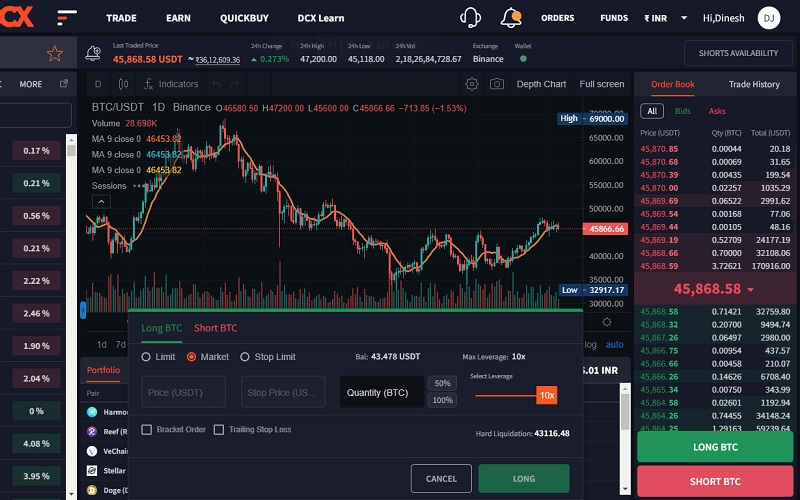
Crypto margin trading allows traders to control a larger cryptocurrency position than they could normally afford by using borrowed funds or leveraged exposure.
The attraction is straightforward: leverage can increase the potential return from a relatively small amount of capital. But the same mechanism also increases losses. A relatively small move in the wrong direction can significantly reduce your margin and, in some circumstances, trigger liquidation.
Understanding how crypto margin trading works is therefore essential before using leverage.
In this guide, we explain crypto margin trading in simple terms, including leverage, margin requirements, long and short positions, isolated and cross margin, liquidation, fees, and practical risk-management techniques.
Risk warning: Crypto margin trading is high risk. Leverage magnifies both gains and losses, and a leveraged position can be liquidated when its collateral is no longer sufficient to meet the platform’s requirements. This article is for educational purposes only and is not financial advice.
What Is Crypto Margin Trading?
Crypto margin trading is a method of trading cryptocurrency using borrowed funds or leveraged exposure to control a position larger than your available capital.
The money you provide is generally used as margin or collateral. Depending on the platform and product, you may borrow additional assets for a spot-margin trade or use a leveraged derivative such as a futures or perpetual contract.
For example, suppose you have $1,000 and use 5x leverage.
Instead of controlling a $1,000 position, you could control approximately $5,000 of market exposure.
If the asset increases by 10%, the position gains approximately $500 before fees and other costs.
However, if the asset falls by 10%, the position loses approximately $500.
That means a 10% market movement represents roughly a 50% gain or loss relative to the original $1,000 margin.
This is the fundamental principle of leverage: your market exposure becomes larger than your own capital, so both profits and losses are amplified.
How Does Crypto Margin Trading Work?
The basic process can be divided into several steps:
- Deposit collateral into a margin or derivatives account.
- Choose the amount of leverage you want to use.
- Select a trading direction, such as long or short.
- Open the position using your available margin.
- Monitor the position, including its margin level and liquidation price.
- Close the trade manually or allow the platform’s risk system to close it if liquidation conditions are reached.
The exact mechanics vary between exchanges and products, so traders should always check the platform’s rules before opening a leveraged position.
A Simple 5x Leverage Example
Imagine that you deposit $1,000 and open a $5,000 position using 5x leverage.
| Market movement | Approximate P&L on $5,000 position |
|---|---|
| +10% | +$500 |
| +5% | +$250 |
| -5% | -$250 |
| -10% | -$500 |
These figures are simplified examples and exclude trading fees, borrowing costs, funding payments, slippage, and liquidation mechanics.
The important point is that the percentage movement applies to the larger position, not merely to the amount you initially deposited.
What Is Leverage in Crypto Trading?
Leverage is the ratio between the size of your trading position and the amount of capital you provide as margin.
For example:
- 2x leverage means $1 of margin controls approximately $2 of exposure.
- 5x leverage means $1 controls approximately $5.
- 10x leverage means $1 controls approximately $10.
Higher leverage gives you greater market exposure with less initial capital, but it also leaves less room for the market to move against you.
For this reason, using the maximum leverage offered by an exchange does not necessarily make a trade better. In many cases, excessive leverage simply brings the liquidation point closer to the entry price.
Initial Margin vs. Maintenance Margin
Two important concepts in leveraged trading are initial margin and maintenance margin.
Initial Margin
Initial margin is the amount of collateral required to open a position.
For example, if a platform requires 20% initial margin for a particular position, you would need approximately $1,000 to control a $5,000 position.
Maintenance Margin
Maintenance margin is the minimum amount of equity or collateral required to keep a leveraged position open.
If losses reduce your account equity too far, you may approach a margin call or liquidation threshold.
The exact calculation differs between platforms and products, so traders should use the exchange’s published formulas and liquidation information rather than relying on a simple percentage estimate.
What Is a Margin Call?
A margin call is a warning that your available margin or account equity has fallen toward a required minimum.
Depending on the platform, a trader may be able to:
- Add more collateral
- Reduce the position size
- Close the position
- Wait for the market to recover, although this can increase risk
If the account continues deteriorating and the required margin level is breached, the platform may liquidate some or all of the position.
Not every crypto platform uses the term “margin call” in exactly the same way, so traders should understand the specific liquidation rules of the platform they use.
What Is Liquidation in Crypto Trading?
Liquidation occurs when a trading platform forcibly closes a leveraged position because the account no longer has enough collateral to support it.
This is one of the biggest risks of crypto margin trading.
Suppose you open a leveraged Bitcoin position and the market moves sharply against you. Your unrealized loss reduces the equity supporting the position.
If that equity falls below the platform’s required maintenance level, the exchange’s risk engine may begin closing the position.
Liquidation can happen quickly during highly volatile market conditions.
It is therefore dangerous to assume that you will always have enough time to manually close a losing position.
Why Does Leverage Increase Liquidation Risk?
Consider two traders:
- Trader A uses 2x leverage.
- Trader B uses 10x leverage.
Trader B has five times the exposure relative to their margin.
As a result, the same percentage price movement produces a much larger percentage change in Trader B’s collateral.
This is why high leverage can make liquidation much more likely.
Long vs. Short Margin Trading
Crypto margin trading can be used to speculate on both rising and falling markets.
Long Position
A long position is opened when a trader expects the cryptocurrency’s price to increase.
For example:
Bitcoin is trading at $100,000 and a trader opens a leveraged long position expecting Bitcoin to rise.
If Bitcoin rises, the position can generate a profit.
If Bitcoin falls far enough, the position can incur significant losses and may eventually be liquidated.
Short Position
A short position is opened when a trader expects the cryptocurrency’s price to decline.
The trader attempts to profit from a falling price.
For example:
Bitcoin is trading at $100,000 and a trader opens a short position expecting the price to fall.
If Bitcoin falls, the short position can generate a profit.
If Bitcoin rises sharply, however, the trader suffers losses.
Short positions can be particularly risky during sudden rallies or short squeezes.
Isolated Margin vs. Cross Margin
Many trading platforms offer two major margin modes: isolated margin and cross margin.
What Is Isolated Margin?
With isolated margin, a specific amount of collateral is assigned to an individual position.
The main advantage is risk containment.
If that position is liquidated, the loss is generally limited to the margin allocated to that position, subject to the platform’s rules.
Isolated margin may be useful when:
- You want to define the maximum collateral allocated to a trade.
- You are trading several independent positions.
- You want clearer position-level risk control.
What Is Cross Margin?
With cross margin, available collateral can be shared across multiple positions or used to support an open position.
This can provide more flexibility and potentially delay liquidation during temporary market movements.
However, it also means that losses from one position can affect more of your available account collateral.
Cross margin may be useful for experienced traders who understand portfolio-level risk, but it can expose more of an account to a losing position.
Isolated vs. Cross Margin
| Feature | Isolated Margin | Cross Margin |
|---|---|---|
| Collateral | Assigned to a position | Shared across positions/account |
| Risk control | More position-specific | More account-wide |
| Capital efficiency | Lower | Potentially higher |
| Impact of a losing trade | Generally limited to allocated margin | Can affect shared collateral |
| Beginner friendliness | Easier to understand | More complex |
The exact rules differ between exchanges, so always check the platform’s documentation.
Crypto Margin Trading vs. Futures Trading
Margin trading and futures trading are often confused because both can use leverage.
However, they are not identical.
Spot Margin Trading
In traditional crypto spot margin trading, a trader can borrow assets or funds and use them to buy or sell cryptocurrency in the spot market.
Borrowing costs, interest, collateral requirements, and liquidation rules can apply.
Crypto Futures and Perpetuals
Futures are derivative contracts whose value is linked to an underlying cryptocurrency.
Perpetual futures are similar to futures but generally do not have a fixed expiration date.
Instead of simply borrowing an asset for a spot transaction, traders take a leveraged derivative position.
Perpetual contracts commonly use funding payments between long and short traders.
Therefore:
Spot margin = leveraged trading involving the spot market and borrowing.
Futures/perpetuals = leveraged derivatives that provide price exposure without necessarily owning the underlying cryptocurrency.
Both can be highly risky.
What Is a Funding Rate?
Funding rates are primarily associated with perpetual futures.
They are periodic payments between traders on opposite sides of a perpetual contract.
The funding mechanism helps keep the perpetual contract’s price aligned with the underlying spot market.
Depending on the funding rate and your position, you may either pay funding or receive it.
This means traders should consider funding costs when holding leveraged perpetual positions for extended periods.
Costs of Crypto Margin Trading
Leverage does not come free.
Depending on the product and platform, costs can include:
Trading Fees
Exchanges generally charge fees when you open or close positions.
Borrowing Interest
Spot margin positions may involve interest on borrowed funds or assets.
Funding Payments
Perpetual futures may involve periodic funding payments.
Spread and Slippage
The difference between buy and sell prices, together with execution slippage, can reduce your returns.
Liquidation Fees
Some platforms may charge liquidation-related fees or penalties.
For this reason, a trade that appears profitable based only on price movement may produce a smaller return after all costs are included.
Advantages of Crypto Margin Trading
Margin trading has legitimate uses when applied carefully.
1. Greater Capital Efficiency
Traders can obtain greater market exposure without committing the entire position value as upfront capital.
2. Ability to Trade Both Directions
Margin and derivatives markets can allow traders to take both long and short positions.
3. Hedging
Experienced traders may use leverage to hedge exposure elsewhere in their portfolio.
4. Flexible Trading Strategies
Leverage can be incorporated into short-term trading, hedging, arbitrage, and other advanced strategies.
However, these advantages do not remove the underlying risks.
Risks of Crypto Margin Trading
The risks are significant and should be understood before using leverage.
1. Amplified Losses
Leverage magnifies losses as well as gains.
2. Liquidation
A sufficiently large adverse price movement can force the position to close.
3. Volatility
Cryptocurrency markets can experience rapid price movements, increasing liquidation risk.
4. Borrowing and Funding Costs
Interest and funding payments can reduce returns.
5. Emotional Trading
Leverage can make normal market fluctuations feel much more significant, which can lead to impulsive decisions.
6. Platform Risk
Your funds and positions are also exposed to the risks associated with the exchange or platform you use.
7. Liquidity and Slippage
During extreme market conditions, executing a position at the expected price may become difficult.
Is Crypto Margin Trading Safe?
Crypto margin trading is not considered a low-risk trading strategy.
The underlying cryptocurrency may already be volatile, and leverage increases the sensitivity of your position to price movements.
A trader can therefore lose money much faster than in ordinary spot trading.
For beginners, learning how spot trading works and developing basic risk-management skills before using leverage may be a more sensible approach.
How to Manage Risk When Margin Trading Crypto
Risk management is more important than simply choosing a leverage number.
Use Smaller Position Sizes
Avoid putting a large percentage of your trading capital into one leveraged position.
Avoid Excessive Leverage
Higher leverage does not automatically increase the quality of a trade.
Lower leverage provides a larger buffer against ordinary market volatility.
Understand Your Liquidation Price
Before opening a position, know approximately where liquidation could occur.
Do not rely solely on the percentage displayed next to the leverage selector.
Consider a Stop-Loss
A stop-loss can help close a position before losses become larger.
However, a stop-loss is not guaranteed to execute at the exact price during extreme volatility or poor liquidity.
Monitor Funding and Borrowing Costs
For positions held over longer periods, recurring costs can become significant.
Never Risk Money You Cannot Afford to Lose
Leverage should never be used with money needed for rent, bills, debt payments, emergency expenses, or essential living costs.
Common Crypto Margin Trading Mistakes
Beginners frequently make several avoidable mistakes.
Using the Maximum Available Leverage
Just because an exchange offers 50x or 100x leverage does not mean a trader should use it.
Ignoring Liquidation Price
Watching only unrealized profit and loss can hide how close a position is to liquidation.
Trading Without a Plan
Entering a leveraged trade based on FOMO, social media posts, or a sudden price movement can lead to unnecessary losses. Traders who use automation should also understand how crypto trading robots work before relying on automated strategies for leveraged positions.
Averaging Down Without Limits
Adding collateral or increasing a losing position does not automatically make the original trade correct.
Ignoring Fees
Trading fees, borrowing costs, funding payments, and slippage can materially affect performance.
Using Cross Margin Without Understanding It
Cross margin can expose more of an account’s available collateral to a losing position.
Crypto Margin Trading Checklist
Before opening a leveraged trade, ask yourself:
- Do I understand the asset I’m trading?
- Do I understand how the leverage works?
- What is my maximum acceptable loss?
- What is the estimated liquidation price?
- Am I using isolated or cross margin?
- What fees or funding payments apply?
- Where will I exit if the trade goes against me?
- How much of my total trading capital am I risking?
- Can I afford to lose the amount allocated to this trade?
If you cannot answer these questions, you probably need to learn more before opening the position.
Frequently Asked Questions
What is crypto margin trading?
Crypto margin trading allows traders to use borrowed funds or leveraged exposure to control a cryptocurrency position larger than their own capital.
Is margin trading the same as leverage trading?
The terms are often used interchangeably, but they can describe slightly different mechanisms depending on the product. Margin trading generally involves collateral and borrowed funds, while leverage can also be provided through derivatives such as futures.
Can you lose all your money with crypto margin trading?
Yes. A leveraged position can lose its allocated margin and be liquidated. Depending on the platform, product, and account structure, losses can potentially have additional consequences, so traders should understand the applicable terms before trading.
What is a margin call in crypto?
A margin call is a warning or risk state indicating that the collateral supporting a leveraged position is approaching the required minimum.
What happens when a crypto position is liquidated?
When liquidation occurs, the trading platform forcibly closes some or all of the position according to its risk-management system.
What is isolated margin?
Isolated margin assigns collateral to a specific position, helping separate that position’s risk from other positions.
What is cross margin?
Cross margin allows available account collateral to be shared among positions. This can improve capital efficiency but can also expose more of the account to losses.
Is crypto margin trading good for beginners?
Generally, margin trading is more appropriate for traders who already understand spot markets, leverage, position sizing, liquidation, and risk management. Beginners should understand these concepts before using leveraged products.
What is the difference between margin trading and crypto futures?
Margin trading commonly refers to leveraged spot trading using borrowed funds. Futures and perpetuals are derivatives that provide leveraged exposure through contracts. Their fee, funding, collateral, and liquidation mechanisms can differ.
Final Thoughts
Crypto margin trading can increase market exposure while requiring less upfront capital, but leverage is a double-edged sword.
The same mechanism that can amplify a profitable trade can also accelerate losses and trigger liquidation.
Before using margin, understand leverage, initial margin, maintenance margin, liquidation, funding costs, margin modes, and position sizing.
For most traders, the goal should not be to use the highest leverage available. The goal should be to manage risk so that one unexpected market movement does not seriously damage the trading account.
Crypto margin trading is a powerful tool, but it should be treated as an advanced risk-management activity rather than a shortcut to larger profits.
This article is provided for educational and informational purposes only and does not constitute financial, investment, tax, or trading advice. Cryptocurrency and leveraged trading involve substantial risk of loss.