
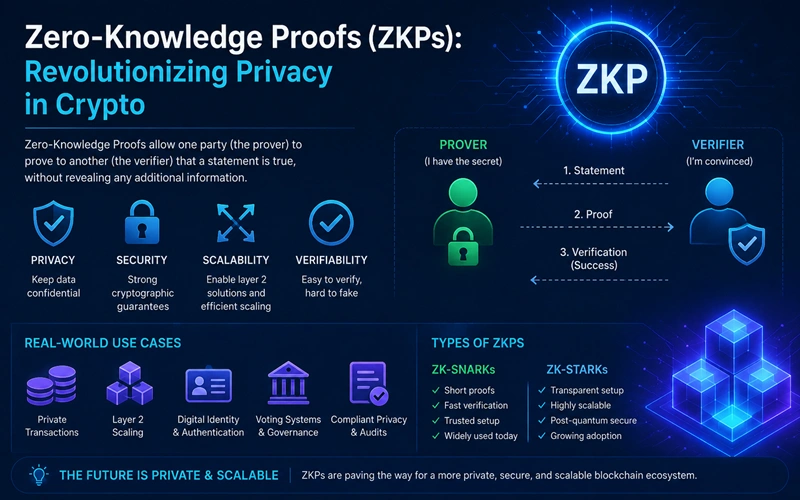
Zero-knowledge proofs (ZKPs) are cryptographic methods that let one party prove a statement is true without revealing the private information used to prove it. They are becoming important in blockchain because public verification and personal privacy often seem to pull in opposite directions. A well-designed zero-knowledge system can let a network verify that a transaction follows its rules, that a user meets an eligibility requirement, or that a computation was performed correctly—while limiting what the verifier learns.
Zero-knowledge proofs are not a magic switch that makes every blockchain transaction anonymous. Their privacy benefits depend on what the application proves, which information remains public, how the software is implemented, and whether metadata can reveal activity. They are also used for scalability: validity proofs can allow a blockchain to verify the correctness of many off-chain operations without repeating every computation on the base network.
This guide explains how zero-knowledge proofs work, the difference between privacy and scaling, the main proof systems, real-world use cases, benefits, limitations, and practical questions to ask when evaluating a ZK-powered project.
What Is a Zero-Knowledge Proof?
A zero-knowledge proof is a cryptographic protocol through which a prover convinces a verifier that a particular statement is true without revealing the secret information—the witness—that makes the statement true. The verifier learns that the claim satisfies the rules, but should learn no additional information about the private witness from the proof itself.
Imagine proving that you are over a required age without sending a full passport scan or revealing your exact birth date. A credential system could issue a cryptographic proof that your date of birth meets the age threshold. The service checks the proof instead of receiving all the personal details on the document. Whether this works in practice depends on the identity system, credential issuer, wallet, and application design.
In blockchain applications, the same general idea can be used to prove that a transaction is valid, that a balance is sufficient, that a computation followed a program’s rules, or that a user belongs to an authorized group. The network can verify the proof without necessarily seeing every private input.
How Do Zero-Knowledge Proofs Work?
A typical ZK system has three important elements:
- Prover: The person, wallet, application, or server that knows the private inputs and generates a proof.
- Verifier: The person, smart contract, or network that checks the proof against a public statement and the system’s verification rules.
- Statement and witness: The statement is the claim being proved; the witness is the secret data that demonstrates the claim is true.
For example, a blockchain application might need to verify that a payment does not exceed a user’s available balance. The prover can construct a proof that the transaction follows the balance and authorization rules. The verifier checks the proof and accepts or rejects the proposed state change. A privacy-preserving design can avoid publishing the exact balance, although the transaction amount, recipient, timing, or other metadata may still be exposed unless the protocol also protects them.
Well-designed zero-knowledge protocols aim to satisfy three core properties:
- Completeness: An honest prover with a valid statement and correct witness can produce a proof that an honest verifier accepts.
- Soundness: A dishonest prover should not be able to convince the verifier that a false statement is true, except with a negligible probability under the protocol’s assumptions.
- Zero knowledge: The proof should reveal no extra information about the witness beyond what is implied by the statement and the protocol’s permitted public outputs.
These properties depend on mathematical assumptions, cryptographic parameters, implementation quality, and correct integration. A flaw in a circuit, verifier contract, random-number generator, or trusted setup can undermine a system even when its high-level design sounds strong.
Zero-Knowledge Proofs and Blockchain: Why They Matter
Blockchains are designed so that participants can independently verify transactions and state changes. Public verification supports transparency, but it can also expose sensitive information. Public wallet addresses can be analyzed over time, and transaction patterns may reveal relationships, income, business activity, or personal habits.
Zero-knowledge proofs can help applications prove that activity follows protocol rules without publishing every detail. They can also help blockchains scale by letting a base layer verify a compact proof of computation performed elsewhere. These are related but distinct uses: a proof used for scaling does not automatically make transactions private. Many ZK rollups publish transaction data or enough information to reconstruct their state, even though they use validity proofs to verify state transitions.
For a broader introduction to the technology behind these systems, see Poolyab’s guide to blockchain fundamentals and blockchain glossary.
Major Types of Zero-Knowledge Proof Systems
ZK-SNARKs
ZK-SNARK stands for Zero-Knowledge Succinct Non-Interactive Argument of Knowledge. SNARK systems can produce relatively small proofs that are quick to verify, making them useful when a blockchain needs to check a proof on-chain. Some SNARK designs require a trusted setup to generate public parameters. The security model depends on how that setup is conducted and whether the relevant secret randomness is properly destroyed. Other proof systems use different setup assumptions, so it is important not to treat every SNARK as identical.
ZK-STARKs
ZK-STARK stands for Zero-Knowledge Scalable Transparent Argument of Knowledge. STARK designs are known for transparent setup properties and for approaches that can scale well for large computations. They often produce larger proofs than some SNARK systems, which can affect data transmission and verification costs. STARKs are commonly described as more resistant to potential quantum attacks than elliptic-curve-based systems, but that does not mean every implementation is automatically future-proof or free from cryptographic risk.
Other proof approaches
The ZK ecosystem includes different protocols, polynomial commitment schemes, interactive and non-interactive constructions, and specialized systems optimized for particular workloads. Some systems prioritize small proofs, others prioritize prover performance, transparency, recursion, or developer experience. Project teams should explain which system they use and why it fits their security and performance requirements instead of relying on the generic label “zero knowledge.”
Zero-Knowledge Proofs for Blockchain Scalability
One of the best-known applications is the zero-knowledge rollup, often called a ZK rollup. A rollup executes many transactions outside Ethereum’s main execution layer, groups the resulting state changes, and submits a validity proof to an on-chain contract. The contract checks the proof before accepting the proposed update.
This approach can reduce the amount of computation that Ethereum mainnet must repeat for every transaction. Rollups still need to publish data that allows users or independent operators to reconstruct state, and they must handle sequencers, proof generation, upgrades, bridges, and data availability. Transaction fees therefore depend on several factors, including proof costs, data publication, network demand, and the rollup’s design.
It is useful to distinguish three concepts:
- Validity proof: Cryptographic evidence that a proposed state transition follows specified rules.
- Data availability: Access to the information required to reconstruct or independently verify the rollup’s state.
- Transaction privacy: Protection for sensitive transaction details, which requires additional protocol and application design.
A rollup may use validity proofs and still publish transaction data. This can improve scalability without hiding balances, addresses, or activity. For the current architecture and trade-offs, read the Ethereum.org documentation on zero-knowledge rollups.
Real-World Use Cases for Zero-Knowledge Proofs
1. Private cryptocurrency transactions
Privacy-focused payment systems can use ZK proofs to demonstrate that transfers follow rules—such as authorization and conservation of value—without publicly disclosing every transaction detail. A complete privacy design must also consider sender and recipient information, amounts, timing, network metadata, wallet behavior, and how funds enter or leave the system. Privacy is only as strong as the whole system, not the proof alone.
2. Identity verification and selective disclosure
Zero-knowledge proofs can help people demonstrate that they meet a requirement without sharing an entire identity document. Examples include proving an age threshold, residency condition, professional qualification, or membership status. Applications must still consider who issued the credential, whether it has expired or been revoked, how keys are protected, and what information the verifier can correlate across visits.
Related topic: blockchain identity verification and KYC/AML.
3. Decentralized finance (DeFi)
DeFi applications can use proofs to validate collateral requirements, transaction rules, or eligibility while revealing less information than a fully transparent process. But privacy can complicate compliance, auditing, risk monitoring, and user protection. Developers need to define which data is private, which facts remain public, and how the protocol responds to invalid inputs or compromised credentials.
4. Voting and governance
Proof systems can help verify that a ballot comes from an eligible participant and is counted according to the rules without publishing the participant’s choice. A secure voting design also needs protection against duplicate voting, coercion, compromised devices, vote buying, and metadata leakage. ZK proofs can support a voting system, but do not independently solve every election-security problem.
5. Healthcare and sensitive records
Healthcare applications may need to prove that a record meets a condition or that a patient qualifies for a service without distributing a complete medical file. Sensitive data should generally be kept in appropriately protected systems, with cryptographic proofs used for narrowly defined verification tasks. Access controls, consent, recovery, auditability, and applicable privacy laws remain essential.
See Poolyab’s related article on blockchain, healthcare data security, and interoperability.
6. Business and supply-chain verification
Businesses may need to demonstrate that a shipment, supplier, product, or compliance record meets defined requirements without exposing every commercial detail. ZK proofs can support selective disclosure, but the underlying data still needs reliable collection and trustworthy sources. A proof can show that an input satisfies a rule; it cannot independently guarantee that a physical-world claim was honestly measured in the first place.
7. Private access and membership
Applications can use ZK proofs to verify that a user is authorized to access a community, service, or digital resource without publishing a reusable identity or membership list. Designers should prevent replay attacks and consider whether repeated use can be linked to the same person.
Benefits of Zero-Knowledge Proofs
- Data minimization: Applications can verify a limited claim without collecting every piece of information behind it.
- More selective privacy: Users may disclose only the facts needed for a specific interaction.
- Verifiable computation: A verifier can check a result without repeating the full computation.
- Potential scalability gains: Validity proofs can help Layer 2 systems batch and verify transactions efficiently.
- Reduced reliance on trust: Correctly designed protocols can replace some manual checks with public, cryptographic verification.
- Flexible application design: The same general techniques can be applied to finance, identity, governance, credentials, and other domains.
Limitations, Risks, and Trade-Offs
Computational cost
Generating proofs can require substantial computation, memory, or specialized hardware. The prover’s cost may be much higher than the verifier’s cost, and performance varies significantly between proof systems and workloads. This can affect mobile devices, decentralization, transaction fees, and the number of independent participants able to operate a service.
Complex implementation
Developers must translate application rules into circuits or another proof-friendly representation. Errors in constraints can leave important conditions unchecked. Auditing a ZK application may require expertise in the application code, circuit logic, cryptography, smart contracts, and the surrounding infrastructure.
Setup and cryptographic assumptions
Some systems depend on a trusted setup or other cryptographic assumptions. Projects should document setup ceremonies, parameter generation, cryptographic libraries, upgrade processes, and how the system would respond if an assumption were weakened.
Privacy leaks outside the proof
A proof may hide a witness while the application leaks information through public inputs, transaction timing, IP addresses, wallet reuse, analytics, or user behavior. Privacy reviews should consider the complete data flow and likely adversaries, not only the mathematical proof.
Data availability and censorship
For rollups, a valid proof does not automatically ensure that users can access the data needed to reconstruct state or exit safely. Operators may also influence transaction ordering or delay inclusion. Users should understand the rollup’s data-availability model, withdrawal process, emergency exits, upgrade controls, and operator dependencies.
Limited interoperability and usability
Different ZK systems may use different circuits, keys, virtual machines, and developer tooling. Wallet support, proof-generation time, recovery options, and cross-chain interactions can make the experience more difficult than a conventional application.
Zero-Knowledge Proofs and Blockchain Security
ZK technology can improve verification, but it does not remove the need for a comprehensive security process. A system may have a mathematically sound proof protocol and still contain a vulnerable smart contract, unsafe administrative key, faulty bridge, or flawed business rule. Review the full architecture, including circuits, verifier contracts, dependencies, upgrade authority, and operational procedures.
For more background, see Poolyab’s guides to blockchain security risks and blockchain security audits and smart contract protection. An audit can reduce risk, but it cannot guarantee that a system is completely secure.
How to Evaluate a ZK-Powered Crypto Project
Before using a ZK wallet, protocol, or rollup, consider these questions:
- What exactly is proved? Read the public statement and understand which inputs remain private and which outputs are visible.
- What data is published? For rollups, confirm what transaction or state data is posted and how users can retrieve it.
- Who generates proofs? Determine whether proving is open to many participants or depends on a small number of operators or specialized machines.
- What are the trust assumptions? Look for documentation about setup ceremonies, cryptographic assumptions, privileged roles, and upgrade keys.
- Has the implementation been reviewed? Look for technical documentation, independent audits, public repositories, disclosed limitations, and a responsible vulnerability-reporting process.
- Can users exit or recover? Understand wallet recovery, account abstraction, bridge risk, withdrawal procedures, and what happens if an operator stops cooperating.
- Does the privacy claim match reality? Check whether metadata, public addresses, deposits, withdrawals, or application logs can reveal user activity.
- Are performance claims measured? Seek reproducible data about proof-generation time, verification cost, throughput, and fees under realistic conditions.
The Future of Zero-Knowledge Proofs
Research and engineering continue to improve proof generation, recursive proofs, developer tools, hardware acceleration, and integration with smart-contract platforms. These advances may make it practical to verify more complex computations and build applications that reveal less personal or commercial information. At the same time, real-world adoption will depend on usability, costs, standards, security reviews, regulation, and whether people can understand the system’s privacy guarantees.
The most promising direction is not simply hiding everything. Many useful applications need selective disclosure: a user may want to prove eligibility, compliance, or correctness while keeping unrelated information private. Zero-knowledge technology can help make that balance possible, provided projects are clear about their limits and design the full system responsibly.
Frequently Asked Questions
Do zero-knowledge proofs make cryptocurrency transactions anonymous?
Not automatically. ZK proofs can hide selected information, but anonymity depends on the complete protocol, including addresses, amounts, timing, network metadata, and how assets enter or leave the system.
Are zero-knowledge proofs the same as ZK rollups?
No. A zero-knowledge proof is a cryptographic technique. A ZK rollup is a Layer 2 scaling design that uses validity proofs to verify batches of transactions. A rollup may use ZK proofs without making its transactions confidential.
What is the difference between ZK-SNARKs and ZK-STARKs?
They are different families of proof systems with different trade-offs. SNARKs often provide compact proofs and efficient verification, while STARKs emphasize transparent setup properties and scalability for certain workloads. The best choice depends on the application, assumptions, performance, and security requirements.
Can zero-knowledge proofs be hacked?
Cryptographic systems can fail through flawed assumptions, implementation bugs, circuit errors, compromised setup processes, or insecure surrounding applications. Independent review and careful operations are important, and no technology should be treated as risk-free.
Are zero-knowledge proofs used only in cryptocurrency?
No. They can support identity credentials, access control, voting, compliance checks, privacy-preserving analytics, and verifiable computation wherever one party needs to prove a claim while revealing less underlying data.
Will ZK technology make blockchain fees free?
No. Proofs may reduce some costs, but proof generation, data publication, on-chain verification, network demand, and application design still affect fees. Actual savings depend on the system and workload.
Conclusion
Zero-knowledge proofs are an important cryptographic tool for building blockchain applications that can verify claims while limiting data exposure. They support privacy-preserving identity, payments, governance, and other use cases, while validity proofs also help Layer 2 networks verify large batches of computation. These benefits are not automatic: privacy depends on the full system, and scalability depends on proof costs, data availability, and operational design.
When evaluating a ZK-powered project, look beyond the label. Understand what is proved, what remains public, which assumptions are required, how users can exit, and whether the implementation has been independently reviewed. Used carefully, zero-knowledge proofs can help blockchain systems become more private, verifiable, and efficient without asking users to trust every participant blindly.


