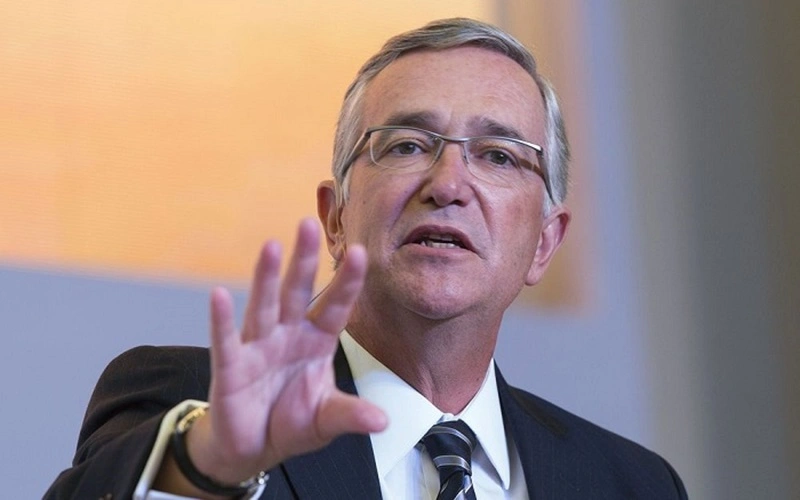
Updated in 2026: Mexican billionaire Ricardo Salinas Pliego has been a prominent Bitcoin supporter for several years. In November 2020, he publicly said that 10% of his liquid assets were invested in Bitcoin. His reported Bitcoin allocation later became considerably larger.
Ricardo Salinas Pliego’s 10% Bitcoin Allocation in 2020
In November 2020, Mexican billionaire Ricardo Salinas Pliego publicly disclosed that Bitcoin represented approximately 10% of his liquid assets.
According to CoinDesk’s November 18, 2020 report, Salinas responded to questions about his position on Bitcoin and said that he had already invested 10% of his cash assets in the cryptocurrency.
“Bitcoin protects the citizen from government expropriation.”
At the time, Salinas also recommended the book El Patrón Bitcoin and discussed his views about Bitcoin, government-issued currencies and precious metals.
It is important to be precise about the original figure: the 10% figure referred to his liquid assets, rather than 10% of his entire net worth. CoinDesk’s original report specifically described the allocation as 10% of his liquid assets.
Why Did Salinas Invest in Bitcoin?
Salinas has repeatedly described Bitcoin as an asset that he believes can provide an alternative to traditional fiat currencies.
His comments have focused particularly on concerns about inflation, currency debasement and the possibility of government interference with private wealth.
These are his stated views and investment rationale. They should not be interpreted as a guarantee about Bitcoin’s future performance.
Bitcoin remains a volatile asset, and its price can rise or fall substantially. An individual’s investment decision also reflects their own financial circumstances, risk tolerance and investment objectives.
Bitcoin, Gold and Fiat Currency
In his 2020 comments, Salinas discussed Bitcoin alongside precious metals. CoinDesk reported that he said the remaining portion of his investments was allocated to precious-metal mining companies.
The comparison between Bitcoin and gold has become a recurring topic in discussions about Bitcoin’s potential role as a scarce asset.
However, the two assets have important differences. Gold has been used as a store of value for thousands of years, while Bitcoin is a relatively new digital asset whose market history is much shorter.
Bitcoin also operates through a decentralized network and uses cryptographic technology rather than physical scarcity.
What Has Changed Since 2020?
The 10% figure from 2020 should not be treated as Salinas Pliego’s current Bitcoin allocation.
His publicly reported position has changed substantially since that original announcement.
In June 2026, CoinDesk reported that Salinas said approximately 70% of his investment portfolio was allocated to Bitcoin. The report also described his continuing preference for Bitcoin over several traditional assets.
This later figure illustrates how his publicly stated exposure to Bitcoin changed between 2020 and 2026:
| Period | Reported Bitcoin allocation | Context |
|---|---|---|
| November 2020 | 10% | 10% of liquid assets, according to his public statement |
| June 2026 | Approximately 70% | Reported as a share of his investment portfolio |
These figures use different descriptions of the asset base, so they should not be treated as a precise like-for-like measurement of portfolio performance. The 2020 statement concerned liquid assets, while the 2026 report referred to his investment portfolio.
Who Is Ricardo Salinas Pliego?
Ricardo Salinas Pliego is a Mexican businessman and the founder and chairman of Grupo Salinas, a business group with interests spanning several industries.
His public profile has made his comments about Bitcoin particularly visible within the cryptocurrency community.
His Bitcoin position has also become part of a broader discussion about how wealthy individuals approach digital assets and alternative stores of value.
Bitcoin as an Alternative Asset
Bitcoin was originally designed as a peer-to-peer electronic cash system, but it has increasingly been discussed as an investment asset and potential store of value.
Some investors view Bitcoin’s limited supply and decentralized architecture as reasons to hold it as part of a broader portfolio. Others emphasize its volatility, regulatory uncertainty and relatively short history compared with traditional assets.
These differences are important when evaluating statements made by individual investors.
Bitcoin’s Limited Supply
One characteristic frequently discussed by Bitcoin supporters is its predetermined supply limit.
The Bitcoin protocol is designed to limit the total number of bitcoins that can ultimately be created to 21 million. New bitcoins enter circulation through the mining process, while the block subsidy is reduced through Bitcoin’s scheduled halving events.
If you want to understand more about the mining side of Bitcoin, see our article on Bitcoin mining with a web browser.
Bitcoin and Inflation Concerns
Inflation is another reason sometimes given for holding scarce assets.
When the purchasing power of a currency declines, investors may look for assets that they believe can preserve value over time. Gold has historically played this role in many portfolios, while Bitcoin has emerged as a newer alternative discussed in this context.
However, Bitcoin itself can experience substantial price volatility. Its market price is determined by supply and demand and can move sharply in both directions.
Bitcoin Is Not the Same as Gold
Although Bitcoin is sometimes compared with gold, there are significant differences.
- Bitcoin is digital, while gold is a physical commodity.
- Bitcoin transactions can be transmitted through a global digital network.
- Gold has a much longer history as a monetary and investment asset.
- Bitcoin’s market has experienced substantial volatility.
- Bitcoin ownership depends on digital keys and wallet security.
- Gold does not depend on the operation of a blockchain network.
For readers interested in Bitcoin’s underlying technology, our article on Bitcoin vs. Bitcoin Cash explains some of the differences between Bitcoin and one of its major forks.
Bitcoin Investment Comes With Risks
Salinas Pliego’s investment decisions represent his own approach to Bitcoin. They should not be interpreted as evidence that the same allocation is appropriate for every investor.
Bitcoin’s price can be highly volatile. Investors can experience significant gains as well as significant losses, and past performance does not guarantee future results.
There are also technological and security risks. Users need to protect private keys, wallet credentials and exchange accounts carefully.
For more information about threats affecting cryptocurrency and blockchain systems, see our guide to Blockchain Security Risks: What You Need to Know.
Why the 2020 Story Still Matters
The original 2020 announcement was significant because it showed that a well-known billionaire was publicly disclosing a meaningful Bitcoin allocation at a relatively early stage of the asset’s institutional adoption.
At that time, Bitcoin was increasingly attracting attention from professional investors, companies and wealthy individuals.
Salinas’s statement therefore became part of a wider conversation about whether Bitcoin could play a role alongside traditional assets such as stocks, cash and gold.
Salinas Pliego’s Bitcoin Position in 2026
By June 2026, his publicly reported position was substantially different from the one he described in 2020.
CoinDesk reported that Salinas said around 70% of his investment portfolio was in Bitcoin. The report also noted that his views on Bitcoin remained closely connected to his concerns about fiat currencies and his preference for scarce assets.
Because this is a statement about a private individual’s portfolio, the figure should be understood as a reported self-disclosure, rather than an independently audited portfolio figure.
What Can We Learn From the Story?
The most useful lesson from Salinas Pliego’s Bitcoin history is not a particular percentage allocation. Instead, it demonstrates how an individual’s view of an asset can change over time.
In 2020, he publicly disclosed a 10% allocation of his liquid assets. By 2026, he was reported as holding approximately 70% of his investment portfolio in Bitcoin.
At the same time, his approach is highly specific to his own circumstances. Other investors have different financial goals, time horizons and risk constraints.
Bitcoin Beyond Investment
Bitcoin is more than an investment asset. It is also a decentralized payment network and an example of blockchain technology operating without a central authority.
The network depends on miners to process transactions and secure the blockchain through proof-of-work.
Bitcoin’s security model is also connected to its decentralized mining network. Readers who want to understand potential blockchain attacks can read our article about 51% attacks and protecting blockchain integrity.
Frequently Asked Questions
Did Ricardo Salinas Pliego invest 10% of his wealth in Bitcoin?
Not exactly. In November 2020, Salinas said that 10% of his liquid or cash assets were invested in Bitcoin. The statement should not be interpreted as saying that 10% of his entire net worth was held in Bitcoin.
How much Bitcoin does Ricardo Salinas Pliego hold?
There is no independently audited public figure establishing his exact current Bitcoin holdings. In June 2026, however, CoinDesk reported that Salinas said approximately 70% of his investment portfolio was allocated to Bitcoin.
Why does Ricardo Salinas Pliego support Bitcoin?
His publicly stated reasons include concerns about fiat currencies, inflation and government control over money and property. These are his stated views and do not constitute a guarantee about Bitcoin’s future value.
Is Bitcoin a safe investment?
Bitcoin carries significant risks, including price volatility, security risks, regulatory changes and the possibility of losing money. The fact that a wealthy investor holds Bitcoin does not establish that the asset is suitable for every investor.
Where can I learn more about Bitcoin?
You can explore our Bitcoin coverage on Poolyab, including ways to make money from Bitcoin, Bitcoin mining with a web browser, and Bitcoin vs. Bitcoin Cash.
Conclusion
Ricardo Salinas Pliego’s Bitcoin story has changed considerably since his widely reported 2020 disclosure.
In November 2020, he said that Bitcoin represented 10% of his liquid assets. In June 2026, he was reported as saying that Bitcoin represented approximately 70% of his investment portfolio.
The two figures describe different points in time and different portfolio bases, so they should not be presented as directly comparable percentages.
What remains clear is that Salinas Pliego has continued to publicly advocate for Bitcoin and has made his own substantial exposure to the asset part of his public investment profile.
For anyone researching Bitcoin, his story is one example of how an individual investor’s allocation can evolve over time. It is not, by itself, evidence that a particular Bitcoin allocation is appropriate for other investors.